
1. The short answer
Armodafinil does not differ from modafinil the way two antidepressants differ from each other. It is one half of modafinil.
Modafinil is a racemate, meaning equal parts of two mirror image versions of the same molecule, labelled R and S. Armodafinil is the R version isolated and sold on its own. Both carry the same molecular formula, C15H15NO2S, and the same molecular weight of 273.35. Stereochemistry is the only structural difference.
The practical consequence is quiet but genuine. Because the two forms leave the body at different speeds, dropping the S form reshapes the concentration curve across the day. Armodafinil does not persist longer in the sense of a longer terminal half life, a misconception the data contradicts, but it does hold higher plasma levels later in the dosing interval.
Whether that matters for any given person is genuinely unsettled, and for many people the honest answer is that it does not.
Modafinil is an even mixture of two mirror image forms of one molecule. Armodafinil is the slower clearing R form on its own, with the fast clearing S form removed.
- Modafinil, R enantiomer50%
- Modafinil, S enantiomer50%
- Armodafinil, R enantiomer100%
- Armodafinil, S enantiomer0%
2. The chemistry of an enantiomer
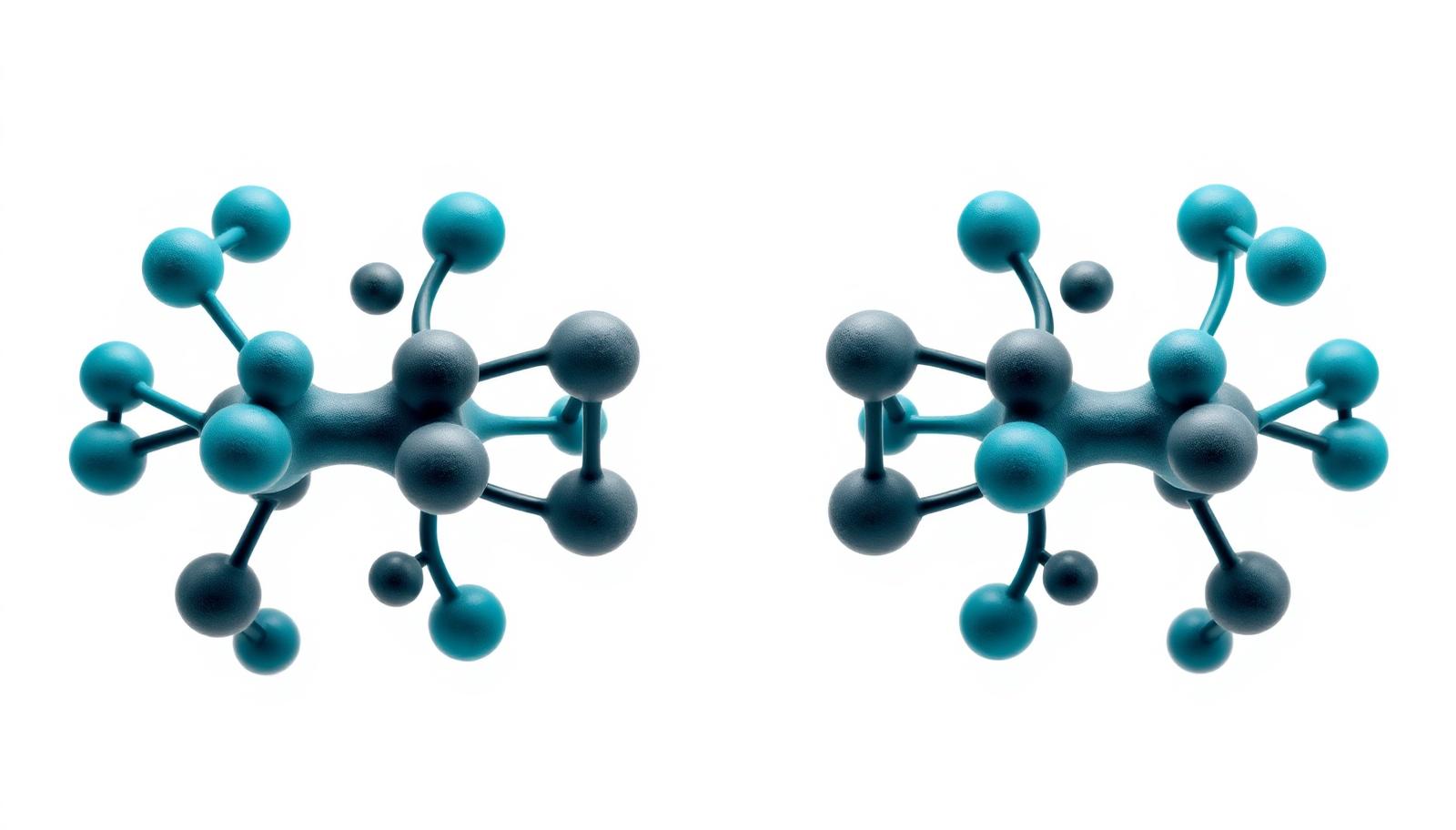
Certain molecules exist in two versions that mirror each other and cannot be laid on top of one another. The usual analogy is a pair of hands, built from the same parts in opposite orientations. Those versions are enantiomers.url, and a molecule with that property is described as chiral.
This carries pharmacological weight because biological receptors are themselves three dimensional and chiral. A receptor that binds one enantiomer well may bind its mirror image weakly, differently, or not at all. Drug metabolising enzymes show the same kind of selectivity.
Modafinil is chiral. It was developed, manufactured and approved as a racemate, a half and half blend of R modafinil and S modafinil. That was and remains ordinary practice, and many marketed drugs are racemates.
The two forms behave quite differently once absorbed. The R form has a half life three to four times longer than the S form. The S form clears quickly while the R form lingers. Armodafinil is pure R modafinil.
3. Side by side comparison
| Modafinil | Armodafinil | |
|---|---|---|
| Brand name | Provigil | Nuvigil |
| FDA approval | 1998 | 2007 |
| Composition | Racemic, 50% R form and 50% S form | R form only |
| Molecular formula | C15H15NO2S | C15H15NO2S, identical |
| Standard daily dose | 200 mg | 150 mg |
| Terminal half life | About 13 hours, reported range 14 to 15 hours | About 13 hours, reported range 10 to 15 hours |
| Plasma decline pattern | Biphasic, rapid early S form clearance then a slower phase | Monophasic |
| AUC at matched milligrams | Reference | Roughly 33 to 40% higher |
| Late day plasma levels | Lower | Higher |
| Peak concentration | Similar | Similar |
| Time to peak | 2 to 4 hours | 2 to 4 hours |
| Approved indications | Narcolepsy, obstructive sleep apnea, shift work disorder | Narcolepsy, obstructive sleep apnea, shift work disorder |
| US scheduling | Schedule IV | Schedule IV |
| Generic availability | Yes, since 2012 | Yes |
| Marketed in Canada and the UK | Yes | No |
4. The half life paradox
This is the part of the comparison most often reported wrongly, including by sources that ought to know better.
The common claim runs that armodafinil has a longer half life than modafinil and therefore lasts longer.
What the data shows is different. A pooled analysis of three randomised single dose pharmacokinetic studies in healthy adults found both drugs had a mean terminal elimination half life of roughly 13 hours, with similar peak concentrations and similar time to peak. The half lives are effectively the same.
The real difference lies in the shape of the curve after the peak.
- Modafinil declines in two stages, a steep early drop as the S form is cleared, followed by a slower phase as the R form persists.
- Armodafinil declines in one stage, because there is no S form to clear quickly and so no early steep drop.
Both drugs finish with a terminal half life of roughly 13 hours. Modafinil falls in two stages because the S form clears quickly, so it enters that final stage with less on board. Armodafinil declines in one smooth phase and sits higher late in the day.
Illustration of the published curve shapes across 24 hours, not measured concentrations.
The consequence is that at matched milligrams armodafinil produces roughly 33 percent greater AUC to the last measurement and 40 percent greater AUC to infinity, meaning more total systemic exposure, along with noticeably higher plasma levels late in the day.
A separate crossover study in patients with treated obstructive sleep apnea compared 200 mg of each and found greater systemic exposure with armodafinil after both single and repeated dosing. The profiles differed enough that the two drugs did not satisfy FDA bioequivalence criteria, which is a formal way of saying they are genuinely not interchangeable milligram for milligram.
Matched milligram for milligram, armodafinil delivers more total drug exposure. That gap is the reason the standard dose is 150 mg against 200 mg, and the reason the two did not meet bioequivalence criteria.
- Modafinil, mg for mgReference exposure
- Armodafinil, AUC to last measureAbout 33% higher
- Armodafinil, AUC to infinityAbout 40% higher
Both of the following are true, which is why the point gets garbled.
- The terminal half lives are approximately the same.
- Armodafinil maintains higher concentrations later in the day.
5. Is armodafinil stronger
Milligram for milligram, yes, in the narrow sense that equal doses deliver greater systemic exposure. That is why the standard dose is 150 mg for armodafinil against 200 mg for modafinil, and why a rough clinical equivalence of 150 mg to 200 mg is often quoted.
The word stronger is doing unhelpful work there, for two reasons.
First, at their respective standard doses the two are meant to be roughly equipotent. The dosing difference exists precisely to cancel out the exposure difference. Nobody is prescribed armodafinil to obtain a larger effect. They are prescribed fewer milligrams to obtain a comparable one.
Second, subjective reports diverge substantially from the pharmacokinetics. Some people describe the ratio as closer to one to one, while others find armodafinil clearly stronger per milligram. The measured data supports higher potency per milligram, but individual experience varies widely, and self reported comparisons of this kind are unblinded, uncontrolled and wide open to expectation effects.
There is a plausible pharmacological reason a felt difference might be real rather than imagined. Without the fast clearing S form, armodafinil lacks modafinil's early rapid decline. Some people describe modafinil as having a more pronounced sense of onset and armodafinil as flatter and smoother. That fits the curve shapes, though it has never been tested rigorously.
6. Clinical evidence

Both drugs hold FDA approval for the same three indications: narcolepsy, excessive sleepiness associated with obstructive sleep apnea, and shift work disorder.
Head to head evidence is thinner than two drugs this closely related would suggest. The most cited comparative finding comes from shift work sleep disorder, where a multicentre, randomised, double blind, parallel group study using comparative doses found armodafinil sustained wakefulness for longer, with the modafinil group holding wakefulness poorly across the final third of the night shift.
That result is exactly what the pharmacokinetics predicts. The gap between the two sits late in the dosing interval, so a study built to measure late interval performance is where a difference should surface. It is reasonable evidence, and it is also the scenario most favourable to armodafinil.
Neither drug performed well elsewhere. Neither armodafinil nor modafinil showed significant benefit over placebo for cancer related fatigue in post treatment survivors, which is worth noting because it shows the class does not help every fatigue related condition, and because both are sometimes prescribed off label for exactly that.
Armodafinil has also been examined in narrower off label settings, including effects on cognition in patients with HIV or AIDS and fatigue.
The practical summary is that for the average patient with narcolepsy or sleep apnea taking a morning dose, little separates the two. The case for armodafinil is strongest where sustained late interval wakefulness is the explicit clinical goal, which is why shift work disorder is where the comparative data favours it most.
7. Side effects and safety
The adverse event profiles and interaction profiles of the two run broadly parallel. That is unsurprising given they are the same molecule, and it means essentially everything in a modafinil safety discussion carries across to armodafinil.
- Headache is the most common effect for both, followed by nausea, anxiety, insomnia, dizziness and reduced appetite.
- Serious skin reactions, including Stevens Johnson syndrome, toxic epidermal necrolysis and DRESS, have been reported for both. Postmarketing data for armodafinil has included fatalities linked to drug hypersensitivity including DRESS. Guidance for both is to stop at the first sign of rash.
- Pregnancy warnings apply to both. International regulators have contraindicated use in pregnancy and in women of childbearing potential who are not using effective non hormonal contraception. Where regulators addressed modafinil alone, Canada and the UK among them, that reflected armodafinil not being marketed there rather than any judgment that it is safer.
- CYP3A4 induction and the hormonal contraceptive interaction apply to both.
- Psychiatric effects, including psychosis, mania and suicidal ideation, are reported for both.
- Cardiovascular cautions are identical.
8. Why armodafinil exists
Worth addressing head on, because readers ask and most comparison pages sidestep it.
Modafinil was approved in 1998. Armodafinil was approved in 2007, several years ahead of modafinil's patent protection lapsing and generics entering the market in 2012.
Isolating a single enantiomer from an existing racemic drug, sometimes called a chiral switch, is a well documented route to extending commercial exclusivity as a patent runs out. The pharmaceutical literature discusses it explicitly under the heading of patent cliff mitigation. Familiar parallels include esomeprazole from omeprazole and levocetirizine from cetirizine.
None of that makes armodafinil a sham. The pharmacokinetic differences are real, measurable and clinically coherent, and the shift work finding is genuine. It does explain why a drug this close to an existing one was developed and marketed at that particular moment, and readers deserve that context when weighing marketing claims about its advantages.
Since modafinil generics arrived in 2012, cost has generally favoured modafinil, although this varies by insurance and region.
1998
Modafinil approved
Marketed as Provigil for excessive sleepiness
2007
Armodafinil approved
The isolated R form marketed as Nuvigil
2012
Modafinil generics arrive
Cost calculus shifts back toward modafinil
Today
Same three indications
Narcolepsy, sleep apnea and shift work disorder for both
9. Which one a prescriber might choose
This is a clinical decision. What follows describes how the choice tends to be reasoned about rather than guidance for making it independently.
Considerations that may favour armodafinil
- Shift work disorder specifically, where sustained late interval wakefulness is the goal and the comparative data is strongest.
- A patient whose sleepiness returns in the later part of the day on modafinil.
- A preference for a flatter concentration profile.
Considerations that may favour modafinil
- Cost, since generics have been available longer and it is often cheaper.
- Availability, since armodafinil is not marketed in Canada, the UK and various other countries.
- A longer clinical track record, 1998 against 2007.
- Situations where a shorter effective duration is preferable, such as a risk of sleep disruption from late interval drug levels.
Considerations that favour neither
- Side effect profile.
- Interaction profile.
- Pregnancy safety.
- Abuse potential.
- Approved indications.
10. Frequently asked questions
- Is armodafinil the same as modafinil?
- Not identical, though calling them separate drugs overstates the gap. Armodafinil is the isolated R enantiomer of modafinil, while modafinil is an even mixture of the R and S forms. Same molecular formula, same molecular weight, different stereochemistry.
- Does armodafinil last longer than modafinil?
- That claim is imprecise. Terminal half lives are close to the same, around 13 hours for both. What differs is that armodafinil holds higher plasma levels late in the dosing interval, because modafinil sheds its fast clearing S form early. The lived experience may feel longer, but the reason is not a longer half life.
- Is 150 mg of armodafinil equal to 200 mg of modafinil?
- That is the rough equivalence usually quoted, and it mirrors the standard approved dose of each. At matched milligrams, armodafinil produces roughly 33 to 40 percent greater systemic exposure. Subjective reports vary, and some people find the two closer to equal per milligram than the pharmacokinetics would predict.
- Can you switch between modafinil and armodafinil?
- That is a prescriber's call. The two failed to meet FDA bioequivalence criteria, so they are not interchangeable at equal milligram doses. Any switch involves a dose change rather than a straight substitution.
- Which has fewer side effects?
- Neither, in any meaningful sense. Adverse event rates and drug interactions run similar between them, which follows from their being the same molecule.
- Why is armodafinil unavailable in the UK or Canada?
- It is simply not marketed there. That is a commercial and distribution matter rather than a safety verdict. When Health Canada and the MHRA issued pregnancy related warnings, they named modafinil alone because armodafinil is not sold in those markets.
- Is armodafinil safer during pregnancy?
- No. The same congenital malformation concerns attach to both, and both were named in the Public Citizen petition to the FDA on the issue.
11. References
- Darwish M, Kirby M, Hellriegel ET, Robertson P Jr. Armodafinil and modafinil have substantially different pharmacokinetic profiles despite having the same terminal half lives: analysis of data from three randomized, single dose, pharmacokinetic studies. Clin Drug Investig. 2009;29(9):613 to 623.
- Pharmacokinetics of armodafinil and modafinil after single and multiple doses in patients with excessive sleepiness associated with treated obstructive sleep apnea: a randomized, open label, crossover study. Clin Ther. 2010.
- Bogan RK. Armodafinil in the treatment of excessive sleepiness. Expert Opin Pharmacother. 2010;11(6):993 to 1002.
- McElhiney M, Rabkin J, Van Gorp W, Rabkin R. Effect of armodafinil on cognition in patients with HIV/AIDS and fatigue. J Clin Exp Neuropsychol. 2013;35(7):718 to 727.
- Patent cliff mitigation strategies: giving new life to blockbusters. Expert Opin Ther Pat. 2015;25(12):1353 to 1359.
- PROVIGIL (modafinil) tablets, C-IV. FDA prescribing information.
- NUVIGIL (armodafinil) tablets, C-IV. FDA prescribing information.
- Modafinil. StatPearls, NCBI Bookshelf.
- Public Citizen. Petition to the FDA regarding modafinil and armodafinil use in pregnancy.